SIBO and anxiety: can SIBO make you anxious?

If your anxiety appeared around the same time as your digestive problems, or becomes noticeably worse when your gut symptoms flare, it is probably no coincidence.
SIBO can contribute to anxiety.
That doesn’t mean everyone with SIBO will feel anxious, or that every case of anxiety comes from the gut. But anxiety is one of the strange symptoms of SIBO that can sit outside the obvious bloating, pain and bowel changes, and there is research linking SIBO with higher levels of anxiety [1][2]. That said, the relationship can definitely work both ways.
Once anxiety becomes established, particularly when you’re dealing with unpredictable pain, bloating, nausea or food reactions, the resulting stress response can affect gut motility and make digestive sensations feel even stronger [3] [4].
For some people, SIBO and anxiety can therefore become part of a self-reinforcing loop.
Can SIBO cause anxiety?
Yes. SIBO can be one contributor to anxiety.
I think this is really important to note because people with chronic or unexplained digestive symptoms are so often told the opposite: that they are anxious, therefore anxiety must be causing their gut problems.
Sometimes anxiety or chronic stress may well have come first, and that can contribute to the gut symptoms, but sometimes the gut symptoms came first.
Perhaps you weren’t particularly anxious before your digestion changed. Then you developed an sense of unease that didn’t feel like you, physical anxiety from nowhere, or panic alongside your digestive symptoms.
There is evidence supporting that relationship. One study comparing people with SIBO against people without it found significantly higher state anxiety and stress in the SIBO group [1], while another study involving people with SIBO found anxiety alongside changes in tryptophan metabolism, with anxiety scores decreasing after antimicrobial treatment [2]. That is particularly interesting because it suggests the relationship may be biological as well as psychological. We still can’t attribute SIBO-related anxiety to one single mechanism, but it adds to the evidence that changes in the gut can influence pathways involved in mood, and I do think it gives us good reason to take the gut-to-brain direction seriously.
Why could SIBO cause anxiety?

There probably isn’t one single pathway. The gut and brain communicate constantly through the gut-brain axis. This communication involves the nervous system, immune signalling, hormones and compounds produced or modified by our gut microbes, so changes within the gut have the potential to change some of the information reaching the brain. [5].
As I keep discussing, I don’t think SIBO is best understood as simply having too many bacteria in the small intestine. Research suggests that symptoms are more closely linked to changes in microbial composition and function than bacterial quantity alone, which is why I think SIBO is best understood as a form of small-intestinal dysbiosis [6].
That matters here because different microbial communities produce different metabolites and interact differently with our immune and nervous systems.
We still don’t know enough about the microbiome to know exactly which of these changes matter most for anxiety in SIBO, and they are unlikely to be identical for everyone- but it gives us several credible ways in which a disrupted small intestinal environment could influence how someone feels mentally as well as physically.
The microbiome may alter signals involved in mood
One particularly interesting area is tryptophan metabolism.
Tryptophan is an amino acid involved in several metabolic pathways, including serotonin and kynurenine pathways that have relevance to brain function and mood.
I have seen it claimed online that ‘SIBO lowers serotonin’, but we don’t have evidence for anything quite that simple.
What we do know is that microbes can influence how tryptophan is metabolised. In one human SIBO study, people with SIBO had altered patterns of tryptophan metabolites alongside anxiety and depressive symptoms. Following rifaximin treatment, some of those metabolites changed and anxiety scores fell [2].
That doesn’t prove that altered tryptophan metabolism was responsible for their anxiety, but it does demonstrate a connection between changes happening in the gut and pathways relevant to mood.
This is one reason I’m uncomfortable with the assumption that anxiety appearing alongside significant digestive symptoms must automatically have started in the brain.
Nutrient deficiencies can link SIBO and anxiety
Nutrient status is another crucial part of this conversation.
Most nutrient absorption happens in the small intestine. When SIBO is severe enough to interfere with digestion and absorption, nutritional deficiencies can sometimes develop.
Vitamin B12 deficiency and other nutritional deficiencies are recognised findings in SIBO (although they are by no means present in everybody who has it) [7], and some nutrient deficiencies can themselves affect how you feel mentally and physically.
Vitamin B12 is essential for normal neurological function, and recognised symptoms of B12 deficiency can include anxiety, depression, cognitive changes and neurological symptoms [8].
Iron deficiency can create another confusing overlap. Fatigue, irritability, difficulty concentrating, breathlessness and light-headedness are all recognised symptoms of iron deficiency, while a 2025 study also found a significant association between a history of iron deficiency and anxiety [9] [10].
This doesn’t mean that low B12 or iron explains anxiety in everyone with SIBO. It means that if someone has significant digestive problems alongside unexplained anxiety, fatigue or neurological symptoms, nutritional status can be a crucial part of the picture, and it’s one of the things I assess first in clinic.
There is also another route to inadequate nutrition that has nothing to do with malabsorption: restriction.
You react to a food, so you remove it.
Another meal causes symptoms, so something else goes.
Eventually your list of ‘safe’ foods becomes smaller and smaller.
I know this pattern extremely well. At my most restricted, I was living on chicken, rice and carrots because I had become so frightened that anything else would make my symptoms worse.
Even without SIBO causing malabsorption, eating such a narrow range of foods makes it increasingly difficult to meet your nutritional needs. It is one reason long-term SIBO diet restriction can become counterproductive when food fear and nutritional adequacy are already part of the problem.
Sometimes anxiety is also a completely understandable response to being unwell
Not every connection between SIBO and anxiety needs a complicated scientific explanation.
Living with persistent gut symptoms can make you really anxious.
You might not know how you’re going to feel after your next meal. You may worry about travelling, eating in restaurants or being somewhere without a toilet. Perhaps you’ve spent months trying different treatments without getting anywhere, or being told that your investigations are normal when you clearly don’t feel normal.
It makes sense that your nervous system starts kicking into overdrive to try to keep you safe, but that still doesn’t mean your gut symptoms were caused by anxiety.
The original problem may have been predominantly physiological. But once you’ve experienced enough pain, urgency, nausea, bloating or unpredictable food reactions, your brain learns that sensations coming from your gut may predict something unpleasant, and that is where the direction of the relationship can begin to change.
How SIBO and anxiety can become a feedback loop
Imagine that SIBO and persistent gut symptoms have made you increasingly anxious. Your brain is now more alert to digestive sensations and you spend more time in a heightened stress state.
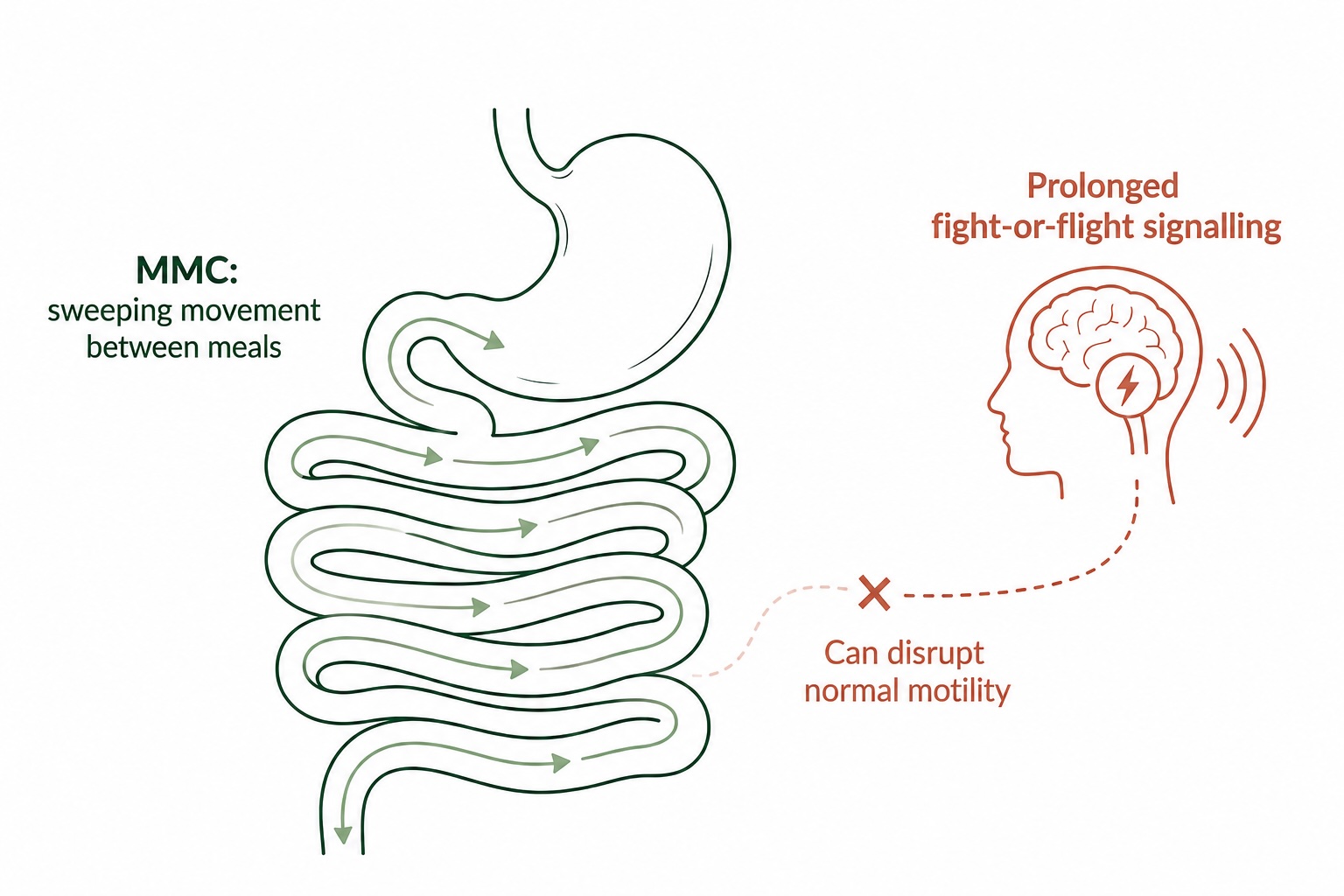
The sympathetic nervous system (our fight-or-flight response) is a normal and essential part of how we respond to threat. The problem isn’t having a stress response – we literally can’t avoid stress – but spending large amounts of time in a state where the body keeps anticipating danger.
During that response, digestion is deprioritised. Sympathetic signalling can reduce coordinated gut contractions and alter fasting motor patterns in the small intestine, including the migrating motor complex, which helps move residual food, secretions and microbes down into the colon between meals [3].
This matters in SIBO because properly functioning small intestinal motility helps maintain a balanced environment. If that movement becomes less coordinated or less frequent, it can create conditions that make small-intestinal dysbiosis harder to shift and symptoms more likely to persist.
Where small-intestinal motility is already impaired, persistent stress may therefore become another influence on a system that is struggling.
That doesn’t mean anxiety automatically causes SIBO. It means someone can start with a genuine gut problem, become anxious because of that problem, and then find that the physiological effects of prolonged stress make the underlying gut problems harder to resolve.
That is very different from saying it is all in your head.
Anxiety can also turn up the volume on gut symptoms
There is another part of the loop that helps explain why symptoms can sometimes escalate.
Your brain doesn’t simply receive signals from your digestive tract – it interprets them. Gas, stretching, movement and pressure in the gut all create signals that need to be processed by the nervous system.
When the gut-brain system becomes more sensitive, those sensations can be experienced much more intensely. This is known as visceral hypersensitivity, and it is particularly well recognised in conditions such as IBS [4].
Anxiety and heightened threat processing can increase attention to gut sensations and lower the threshold at which those signals are interpreted as uncomfortable or threatening, effectively amplifying the brain’s response to the same physical input.
So you can absolutely have two things happening at once – there may be a genuine digestive reason for the sensation, such as gas, distension or altered motility, while at the same time, your nervous system may become increasingly responsive to that sensation.
The symptom is NOT imaginary. But the volume on the signal has also been turned up.
This may partly explain why the severity of somebody’s symptoms doesn’t always correspond neatly with their breath-test numbers or another objective measurement.
How SIBO can create anxiety around food
Food anxiety can develop quickly when eating has repeatedly been followed by pain, bloating, nausea or other unpleasant symptoms. After enough of those experiences, your brain starts to anticipate a problem before it has even happened, so you may find yourself monitoring every sensation during and after a meal and wondering whether a particular food has set something off.

That anticipation matters because it can make eating itself feel stressful. If you are also being told that certain foods ‘feed SIBO’ (FYI, there is NO evidence to support that any food ‘feeds SIBO’!), it becomes very easy to respond by cutting more and more things out. Over time, the combination of symptoms, fear and restriction can make meals feel increasingly unsafe and can also make it harder to meet your nutritional needs.
A short (1-2 weeks maximum) food and symptom diary can still be really useful here. Tracking what you eat and how you feel for a week or so can help you spot an obvious pattern that might otherwise be missed, particularly if there is a genuine allergy, intolerance or another consistent food-related trigger [11].
What I absolutely wouldn’t recommend is tracking every mouthful and every symptom indefinitely. Once you are already anxious about food, prolonged monitoring can encourage even more attention towards normal gut sensations and reinforce the idea that you need to identify a food culprit every time you feel something. Gut-related hypervigilance and anxiety around eating are both associated with greater dietary restriction and poorer food-related quality of life [12] [13], so I would use a diary as a short-term information-gathering tool, rather than something that keeps you permanently watching and analysing your gut.
Reducing certain fermentable foods can sometimes provide useful short-term symptom relief, but that is not the same as changing the underlying gut environment, and again, diet will not treat SIBO. When symptom management turns into long-term restriction, it can add another layer to the SIBO and anxiety cycle rather than resolving it.
Does anxiety make SIBO worse?
Anxiety can potentially make some of the factors associated with SIBO worse, particularly gut motility and symptom sensitivity. That doesn’t mean anxiety is necessarily why you developed SIBO, but it does mean that once the nervous system has become stuck in a heightened threat response, addressing that state can be an important part of recovery.
This is why nervous system regulation is such a big part of the way I work. The aim isn’t to eliminate stress or force yourself to feel calm all the time. It is to help the body move more easily between states of activation and rest, so digestion isn’t continually impaired by a perceived threat. When that changes, it can support more coordinated gut function and reduce the amplification of digestive sensations.
I still wouldn’t look at the nervous system in isolation. If impaired gut movement is a major part of the picture, improving motility may also be important, with prokinetics for SIBO potentially forming one part of that approach for some people. If symptoms have pushed you towards an extremely restricted diet, rebuilding food tolerance and nutritional adequacy may need equal attention.
This is the thinking behind my Brain-Body-Biome approach: the nervous system, digestive function and microbiome can all influence one another. For many people with persistent SIBO symptoms, nervous-system regulation isn’t an optional extra added at the end, but should be one of the foundations that helps the rest of the gut work become more effective.
Does this mean treating anxiety can treat SIBO?
Not by itself, but working on the nervous system can be an important part of treating the wider pattern that keeps SIBO going.
If somebody has impaired motility, small intestinal dysbiosis, poor digestive function or another medical or structural contributor to their symptoms, nervous system work won’t replace addressing those things. But equally, focusing exclusively on bacteria can miss a major part of the gut-brain loop.
This is why nervous system regulation isn’t an optional extra in my clinic. If months or years of symptoms have left the body spending too much time in a heightened threat state, that can continue to affect motility, digestion and how strongly gut sensations are perceived. Helping the nervous system build resilience can therefore support the conditions in which the gut is better able to function.
At the same time, repeatedly trying to reduce bacteria without changing the wider gut environment may only produce temporary improvements. The aim is not to choose between the nervous system, motility, digestion or the microbiome, but to understand how they are interacting and address them in the right order for that person.
That is why treatment order and individual context matter so much.
What if you’ve been told anxiety is causing your SIBO?
Stress absolutely can influence digestion, and prolonged stress can contribute to SIBO through effects on things like gut motility. But that doesn’t mean stress must have been the original cause of the problem, and this is where I think the conversation can become too simplistic, with gut symptoms still too often dismissed by GPs once anxiety enters the picture.
I was repeatedly told that I ‘seemed anxious’ while I was experiencing severe digestive symptoms, and they were right – I was extremely anxious. But I was also in pain, I couldn’t understand why I felt so unwell and I wasn’t getting answers. In my case, reducing everything to anxiety missed an important part of the sequence: the gut problems were helping to create the anxiety in the first place.
For some people, the pattern may look more like small intestinal dysbiosis and gut symptoms >> anxiety >> a more persistent threat response >> changes in motility and symptom sensitivity >> worse gut symptoms >> more anxiety. For somebody else, chronic stress or anxiety may genuinely have come first and contributed to the digestive dysfunction. Once both systems have been influencing each other for long enough, though, working out which one started it can become less useful than understanding what is now keeping the cycle going.
To sum up:
SIBO and anxiety can absolutely be connected, and for some people the relationship runs in both directions.
Changes associated with small intestinal dysbiosis may contribute to anxiety through the wider gut-brain axis, while nutrient deficiencies, inadequate intake and the stress of persistent digestive symptoms can add further pressure [1] [2] [7] [8].
Once anxiety becomes established, that relationship can start to reinforce itself. A more persistent threat response can affect gut motility and increase the intensity with which digestive sensations are experienced, potentially making symptoms harder to settle [3] [4]
So what may begin largely as a gut problem can, over time, become a two-way gut-brain loop. That doesn’t mean every case of anxiety is caused by SIBO, or that nervous-system work alone will resolve it. It means that treating the gut while ignoring the nervous system can be just as incomplete as blaming the whole problem on anxiety.
For a lot of people, the gut really does start the conversation.

I’m Lucy, a Nutritional Therapist specialising in gut health, including SIBO, IBS, functional dyspepsia and histamine-related symptoms. I work with people who feel stuck with ongoing digestive issues despite trying diets, supplements, or standard protocols. My approach focuses on identifying root causes and restoring gut function, alongside supporting the nervous system, rather than relying on restrictive or short-term fixes.
If you’re struggling with persistent gut symptoms and not getting answers, you can book a free gut support call to discuss what you’re experiencing and whether one of my programmes could be the right fit for you.
References:
- https://pmc.ncbi.nlm.nih.gov/articles/PMC9819554/
- https://pmc.ncbi.nlm.nih.gov/articles/PMC9513933/
- https://www.tandfonline.com/doi/10.3109/00365529209011167?url_ver=Z39.88-2003&rfr_id=ori:rid:crossref.org&rfr_dat=cr_pub%20%200pubmed
- https://pmc.ncbi.nlm.nih.gov/articles/PMC4202343/
- https://www.sciencedirect.com/science/article/abs/pii/S0272735820301318?via%3Dihub
- https://pmc.ncbi.nlm.nih.gov/articles/PMC6494866/
- https://www.gastrojournal.org/article/S0016-5085(20)34928-3/fulltext?referrer=https%3A%2F%2Fpubmed.ncbi.nlm.nih.gov%2F
- https://www.nice.org.uk/guidance/ng239
- https://jamanetwork.com/journals/jama/article-abstract/2832131
- https://pmc.ncbi.nlm.nih.gov/articles/PMC12318526/
- https://onlinelibrary.wiley.com/doi/10.1111/nmo.13820
- https://onlinelibrary.wiley.com/doi/10.1111/jhn.13358
- https://pmc.ncbi.nlm.nih.gov/articles/PMC13104586/